
Honouring B.F. Skinner (American Psychologist)
- Hazel S
- Aug 18, 2025
- 4 min read

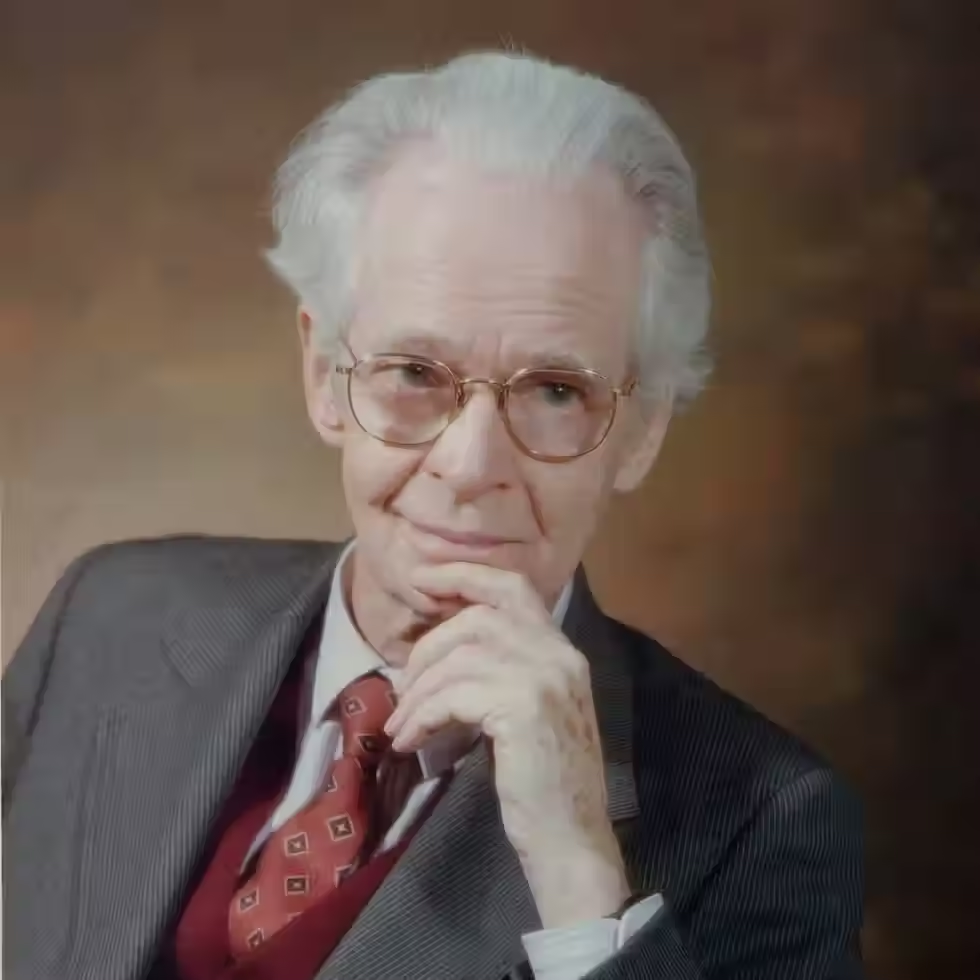
B.F. Skinner (20th March, 1904–18th August, 1990) was a highly influential American psychologist, behaviorist, inventor, and social philosopher. He is considered the most influential psychologist of the 20th century, largely due to his development of the theory of operant conditioning. Skinner himself referred to his philosophy as “radical behaviorism.” He suggested that the concept of free will was simply an illusion and, instead, believed that all human action was the direct result of conditioning.
B.F. Skinner’s influence on psychology, education, and mental health is without question. His work played a major role in the dominance of behaviorism during the first half of the 20th century, and his theories continue to impact areas including education, psychotherapy, early childhood learning, parenting, dog training, and employee training.
Operant conditioning
Operant conditioning is a learning process where an organism’s voluntary behaviors are modified by the consequences that follow them. Unlike classical conditioning, which deals with involuntary responses, operant conditioning focuses on how an organism’s behavior “operates” on the environment to produce consequences.
Skinner identified three types of responses that can follow a behavior:
Reinforcers: Responses from the environment that increase the likelihood of a behavior being repeated.
Positive Reinforcement: Adding a pleasant stimulus to strengthen a behavior (e.g., giving a dog a treat for sitting).
Negative Reinforcement: Removing an unpleasant stimulus to strengthen a behavior (e.g., a car’s seatbelt alarm turns off when you buckle up).
Punishers: Responses from the environment that decrease the likelihood of a behavior being repeated.
Positive Punishment: Adding an unpleasant stimulus to weaken a behavior (e.g., a child getting a scolding for misbehaving).
Negative Punishment: Removing a pleasant stimulus to weaken a behavior (e.g., a parent taking away a child’s video game privileges for getting a bad grade).
To study operant conditioning, Skinner invented the operant conditioning chamber, now commonly known as the Skinner box. This was a controlled environment used to test how an animal’s behavior (like pressing a lever or pecking a key) could be shaped by reinforcement or punishment.
To know more about Operational Conditioning, visit this link https://www.britannica.com/science/operant-conditioning
B.F. Skinner also proposed that emotions could be translated into a person’s predisposition to act in specific ways. For example, if someone experiences anger toward someone else, they are more likely to exhibit behaviors such as yelling at the other person or maybe even physically acting out against them.
Skinner’s remarkable legacy has left a lasting mark on psychology and numerous other fields, ranging from philosophy to education. While behaviorism is no longer a dominant school of thought, his contributions remain vital today.
For instance, mental health professionals often utilize Skinner’s operant techniques when working with clients. Teachers also frequently use reinforcement to shape behavior in the classroom. Even animal trainers rely heavily on B.F. Skinner’s techniques to train dogs and other animals.
Major Contributions and Inventions
Skinner’s work and philosophy had a profound and lasting impact on psychology and other fields. His key contributions include:
Radical Behaviorism: This philosophical approach asserts that all behavior, including internal events like thoughts and emotions, can be understood as a function of environmental history of reinforcement.
The Skinner Box: During his time at Harvard, B.F. Skinner became interested in studying human behavior in an objective and scientific way. He developed what he referred to as an operant conditioning apparatus, which later became known as a Skinner box. The Skinner box was a chamber that contained a bar or key that an animal could press in order to receive food, water, or some other form of reinforcement. Pigeons and rats were often utilized as subjects in studies using this device.
The Cumulative Recorder: It was also during his time at Harvard that B.F. Skinner invented the cumulative recorder, a device that recorded responses as a sloped line. In looking at the slope of the line (which indicated the rate of response), Skinner saw that response rates depended upon what happened after the animal pressed the bar.
That is, higher response rates followed rewards while lower response rates followed a lack of rewards. The cumulative recorder device also allowed Skinner to see that the schedule of reinforcement influenced the rate of response.
Baby Tender: In 1943, B.F. Skinner invented the “baby tender.” The baby tender was an enclosed heated crib with a plexiglass window. Skinner created this device in response to his wife’s request for a safer alternative to traditional cribs.
B.F. Skinner’s Awards and Recognitions
Among the many recognitions that B.F. Skinner received were:
1966 — Edward Lee Thorndike Award, American Psychological Association
1968 — National Medal of Science from President Lyndon B. Johnson
1971 — Gold Medal of the American Psychological Foundation
1972 — Humanist of the Year Award
1990 — Outstanding Lifetime Contribution to Psychology Award, American Psychological Association
Skinner was a prolific author. His most notable books include:
The Behavior of Organisms: An Experimental Analysis (1938): This book laid the foundation for his theories on operant conditioning.
Walden Two (1948): A utopian novel depicting a fictional community founded on his principles of social engineering and behavioral conditioning.
Science and Human Behavior (1953): A comprehensive explanation of behaviorism and how its principles could be applied to human society.
Verbal Behavior (1957): An attempt to apply his principles of operant conditioning to language.
Beyond Freedom and Dignity (1971): A controversial work arguing that human behavior is determined by environmental factors, challenging the traditional concepts of freedom and individual dignity.
Takeaways
B.F. Skinner was a powerful force in the field of psychology. His theories were highly influential, but some of his work generated controversy, including his belief that all human behavior stems from conditioning processes.
You can still see the effects of his theories today. Modern uses for operant conditioning are all around us, such as in rewards programs that encourage good behaviors and therapeutic techniques like contingency management, token economies, behavior modeling, and extinction.


Comments